The Guardian's Perspective
For the one who holds the watch at 3:00 AM. For the one who knows the difference between 'surviving' and 'living'. This is for you.
ANTICIPATORY GRIEF
Angela Human
2/26/20265 min read

The air is heavy in the final days of a pet's life. It is a space filled with quiet observation, constant calculation, and the profound ache of anticipatory grief. For the caregiver, it's not a single decision; it’s a 24-hour cycle of nursing care, medication management, and constant quality-of-life assessments.
Then, the doorbell rings. It's a loved one coming to say goodbye. They sit, they offer a hand to the old cat, or a scratch behind the ears of the senior dog. Hunter, or Luna, or Bella, perks up. The visitor, desperate to offer comfort and find a silver lining, says the words.
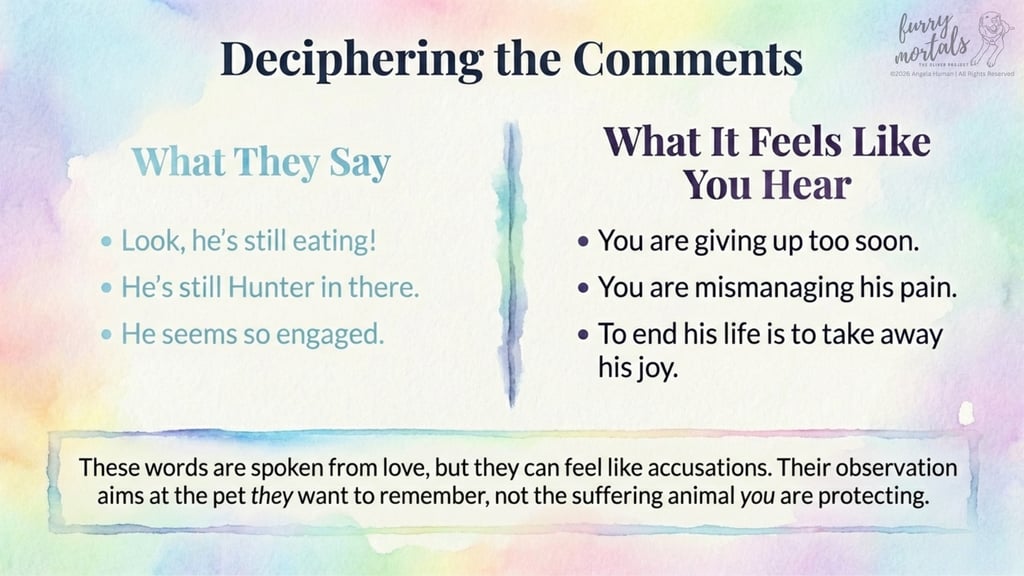
"But look, they’re still eating."
"He's still Hunter in there."
"They're still so engaged!"
These words are spoken from a place of genuine love and a desire to console. But for the person holding the burden of care and decision-making, they often hit with the force of an accusation. In that one observation, the careful, painful assessment of weeks—the nighttime restlessness, the incontinence, the subtle signs of unmanaged pain, the profound fatigue—is seemingly swept aside.
It is one of the loneliest paradoxes of the final journey: the very people trying to support you can unwittingly create a storm of doubt, guilt, and eventually, regret.
The Problem of the "snapshot"
A pet's end-of-life care is not a highlight reel; it is a feature-length documentary of quiet decline. When visitors come, a pet will often experience an "adrenaline spike." Much like a human relative "rallying" when visitors arrive, pets will pull on their last reserves to perform a role they have held for years: the happy greeter.
The visitor sees this snapshot. They see the tail wag for the treat, or the head lift for the pet. What they don't see is the three hours of complete exhaustion that will follow, the refusal to move from the bed for the rest of the day, or the fact that "still eating" only happens because the caregiver spent twenty minutes coaxing them with three different kinds of food and anti-nausea medication.
A pet is not just "Hunter" because they lift their head. They are a complex, biological being, and when their "house" (their body) is falling apart, the essence of "Hunter" is being trapped. The caregiver sees the entire architecture. The visitor sees only the facade.
The Seed of Doubt and the Harvest of Regret
When a well-meaning friend says, "But he’s still so engaged," it plants a dangerous seed: Am I giving up too soon? Am I overreacting to their pain?
The language of console—"Look how peaceful she is,"—can translate in the caregiver's mind as "You must not be managing their comfort correctly if you think they are suffering." "He still loves his walks," can be interpreted as "To end his life is to take away his last joy."
These seeds are what lead to the phenomenon of "the day too late." Fearing the judgment implicit in "they are still Hunter," many owners wait. They wait until the pet has an acute crisis, until there is trauma, until there is unmanageable pain that cannot be mistaken. This choice, often driven by the external validation of "he's still hanging in there," is the path that leads to the deepest regret.
Veteran veterinary staff will almost universally agree: It is far better to be a week too early than a day too late. This allows the end-of-life to be a choice, a calculated mercy, an act of supreme love that prevents suffering, rather than a frantic response to a crisis. But it is incredibly difficult to make that choice when a close friend is telling you your pet is "still in there."
You Are Their Fiercest Advocate
The core truth that every pet owner facing this choice must cling to is this: You are the expert on your pet. You hold the key. You are the one awake at 3:00 AM. You are the one watching the breathing rate, checking the gum color, and tracking the food intake.
A friend’s perspective, no matter how loving, is a snapshot. It lacks the critical context of the care giving journey. While their intent is to console you, their observation often aims at the pet they want to remember, not the suffering animal you are trying to protect.
If you find yourself paralyzed by the doubt these comments create, it can be helpful to have a internal mantra. "They mean well, but they don't know." Repeat it. Their words do not invalidate the reality you are living.
What to Say and How to Help: A Guide for Well-Meaning Friends and Family
If you are the one visiting a loved one and their dying pet, it is natural to want to make it better. You see the grief and you want to offer hope. But in this specific arena, hope can be an unintended pressure.
Your role is not to give a medical or quality-of-life assessment. Your role is to support the owner.
What to Say Instead
The best support is non-judgmental validation. Shift the focus from your own assessment to supporting the caregiver's intuition.
"I can see how much you love him. I trust you know him better than anyone." (This is the single most validating thing you can say.)
"How can I best support you in the decision you have to make?" (This acknowledges the decision is theirs and asks how to help them.)
"Whatever you decide, I am here for you. I know you will choose the kindest thing." (This grants them permission to act without fear of your judgment.)
"Tell me your favorite story about her." (Shift the conversation to memory, which is where they will eventually find solace.)
Say nothing. Just be present. The finality needs silence. Just sit with them.
How to Truly Help
Supporting a friend in this position is about alleviating the logistical and emotional load of caregiving, not just offering "rally" observations.
Handle a logistical task. "I am going to the grocery store, I am bringing back dinner and some ready-to-eat meals for your fridge."
Offer to sit. "I would love to come over and just sit with you both. I can watch him for an hour if you want to take a shower or close your eyes."
Run an errand. "I can pick up the medication from the vet so you don't have to leave her side."
Take care of practicalities around the end of life. "If you are planning an at-home euthanasia, I can coordinate with the service," or "If you need someone to manage the car ride and the pick-up afterward, I will do it."
The kindest gift you can offer a friend in these final days is to fully acknowledge their position. Do not force them to defend their assessment to you. Trust them. They are the only ones who can see the whole, painful, beautiful picture. Validating that vision is the ultimate act of friendship.
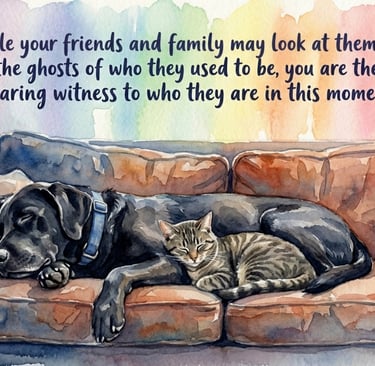
In the end, our pets live in a permanent present. They aren't mourning their past or fearing their future; they are only experiencing the "now" of their physical bodies. While our friends and family may look at them and see the ghosts of who they used to be, you are the one bearing witness to who they are in this moment.
Making the choice to say goodbye is not a betrayal of the "Hunter" they remember; it is the final, most selfless act of protection for the pet you love. Trust your eyes, trust your heart, and remember that you aren't ending a life—you are soul-guarding a friend from a day of suffering they don't have to endure.
Contact
281-531-5820
©2025. All rights reserved.


Angela Human (author)

